Brand Identity in Retail Space: How Your Store Tells Your Story
Brand Identity in Retail Space: How Your Store Tells Your Story
The most powerful advertising a brand owns is not a multi-million-dollar television campaign. It is the moment a customer steps into a store — and it continues long after they have left. Brand identity is far more than a logo or a color palette; it is the sum of every feeling the brand creates at every point of contact. And without question, the most powerful of those touchpoints is the retail space.
This article explores how brand identity lives in physical space, and why aligning the two is one of the most strategic decisions a retail brand can make.
What Brand Identity Actually Is — and What It Is Not
Brand identity is one of the most misunderstood concepts in business. Many owners equate it with "logo, color, font." In reality, brand identity is how a brand exists in the world. It encompasses:
Brand values and promise
Visual language (logo, color, typography, imagery)
Voice and communication style
Customer experience and service standards
Physical environment and atmosphere
Employee behavior and culture
Strong brand identity emerges only when all of these elements work together. Inconsistency in any one of them undermines the whole.
Why Retail Space Is the Strongest Expression of Brand Identity
A customer may spend seconds engaging with a brand digitally — but they spend minutes in a physical environment. In that time, they experience the brand through all five senses. That is why retail space is where brand identity lives most intensely and memorably.
A well-designed retail space:
Makes brand values visible and tangible
Invites the customer into the brand's world
Transforms products from objects into part of a story
Naturally guides employee behavior
Creates clear differentiation from competitors
A poorly designed space does the opposite: it contradicts brand values, alienates customers, and reduces products to commodities.
The Six Dimensions of Translating Identity Into Space
1. Deliberate Use of Color
Every brand color evokes an emotion. Using a strong orange as the dominant color in a luxury brand's flagship will undermine the premium perception, no matter how expensive the materials. Color is not just a decorative choice — it is an emotional code.
Translating brand color into retail space requires care:
The primary color is often best used in controlled accent moments
Secondary colors should balance across larger surfaces
Neutral tones help products stand out
Test how lighting shifts color perception in the actual space
2. The Story Materials Tell
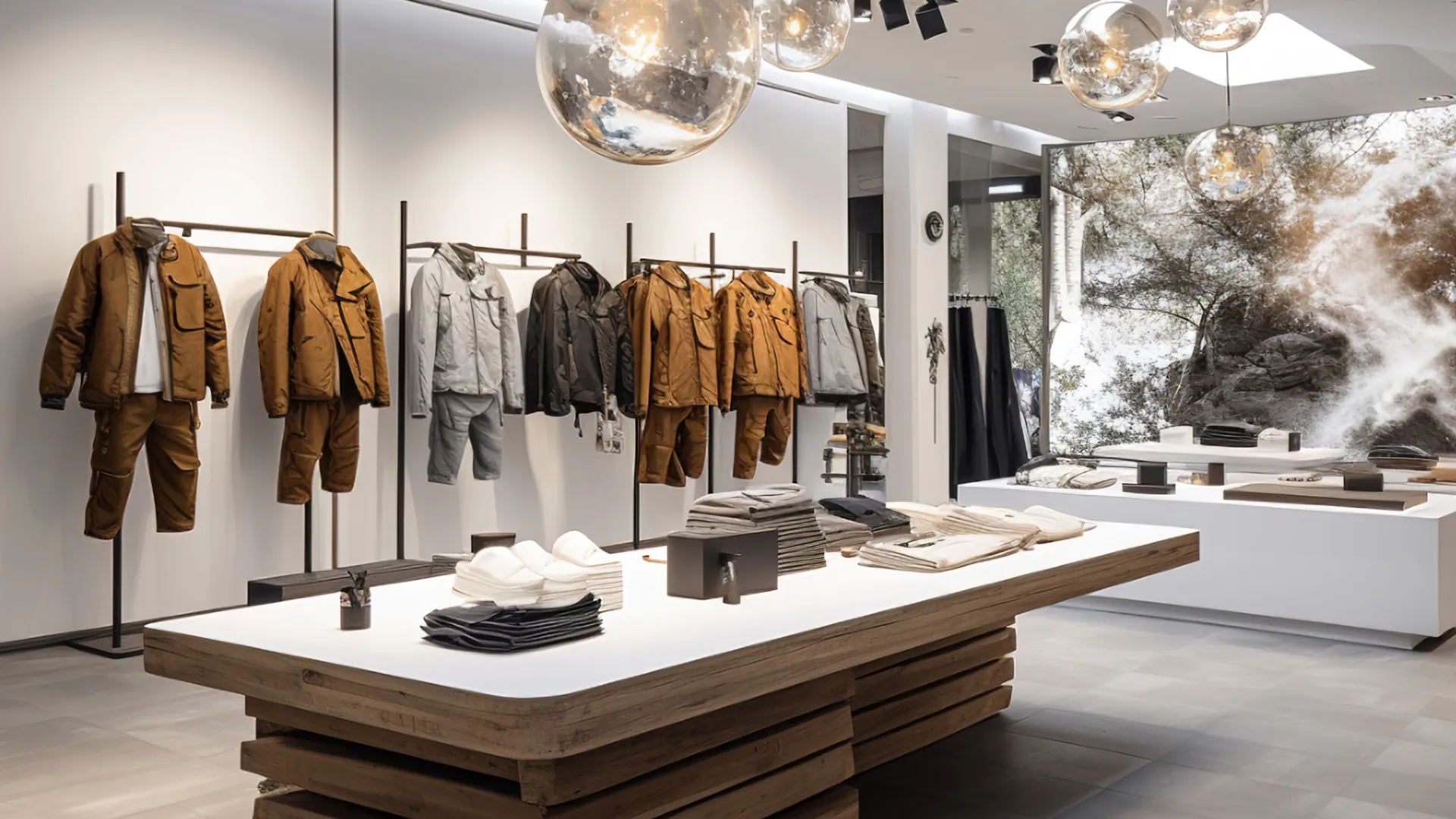
Materials are silent narrators. Solid wood speaks of craft and heritage; polished metal speaks of modernity and technology; organic textures speak of naturalness and sustainability.
Materials misaligned with brand character send the wrong message, no matter how expensive they are. Heavy rustic furniture in a tech brand's flagship is just as wrong as gleaming chrome fixtures in a handmade ceramics boutique.
3. Lighting: The Language of Emotion
Lighting is the most powerful architect of brand atmosphere. The same space, relit, can deliver an entirely different brand experience.
Warm, soft lighting: inviting, emotional, premium
Bright, even lighting: modern, technical, efficient
High-contrast accent lighting: dramatic, luxurious, artistic
A lighting scheme aligned to brand identity can transform the perception of a store on its own.
4. Sound and Scent: The Invisible Layers
Customers remember what they saw in a store — but they never forget how it made them feel. Sound and scent are the subconscious communication channels of brand identity.
The right music extends dwell time and reinforces brand character. Signature scents create powerful memory associations; customers may even come to recognize the brand by its scent alone.
5. Typography and Signage
Every piece of text inside the store — from product labels to information panels, from wayfinding to price signage — should be an extension of brand typography. Random mixing of fonts is one of the clearest signs of brand indiscipline.
6. Employee Experience and Behavior
No matter how beautifully designed a physical space is, if employee behavior does not align with the brand identity, the experience breaks. Brand identity extends beyond decor into how the team speaks, greets, and serves customers.
Great retail design creates an environment in which employees naturally embody the brand character, because the space itself cues the right behaviors.
Misalignment Between Identity and Space: The Silent Killer
Picture a brand whose digital presence is minimalist and premium, yet whose store feels crowded and generic. Or a brand that markets itself on sustainability, but whose store is filled with plastic fixtures. These inconsistencies create subconscious distrust in the customer.
Modern consumers no longer evaluate brands by a single touchpoint. They judge by the coherence of the full experience. Inconsistency is where trust begins to erode.
A Roadmap to Building a Strong Brand Space
Translating brand identity into physical space requires a structured process:
Brand audit: Clear definition of current identity, values, and promise
Customer analysis: Deep understanding of target customer expectations, behavior, and emotional needs
Concept development: Defining the space's core story, atmosphere, and emotional tone
Spatial design: Architectural solutions, material selection, lighting design
Display solutions: Product presentation strategy and campaign areas
Execution and production: Bringing the design to life with quality manufacturing
Measurement and optimization: Tracking performance and continuously improving
Each step connects to the next. Having a single partner manage the entire process dramatically improves the quality of the outcome.
BRANDLINE Solutions: Your Partner in Bringing Brands Into Space
The link between brand identity and retail space is one of the most strategic factors shaping a brand's future. Getting it right requires brand consulting, spatial design, and display production expertise working as one integrated capability.
At BRANDLINE Solutions, we bring these three disciplines together under one roof. We begin by listening to your brand strategy, then design your space, strengthen your identity, and produce your solutions. We believe that bringing a brand to life means turning it into an environment people can genuinely inhabit.
Let's build the physical expression of your brand — together.
Frequently Asked Questions
Our brand identity is already defined. Why do we still need brand consulting for store design? Defining a brand identity and translating it into physical space are two different disciplines. Brand consulting for retail converts identity into spatial decision criteria.
How do I test whether my current store is aligned with my brand? A professional brand-space audit measures the alignment between your store and your brand identity, and identifies specific areas for improvement.
Does this process work for small brands too? Yes — and arguably it matters even more for small brands, because differentiation is their most valuable asset.